Introduction
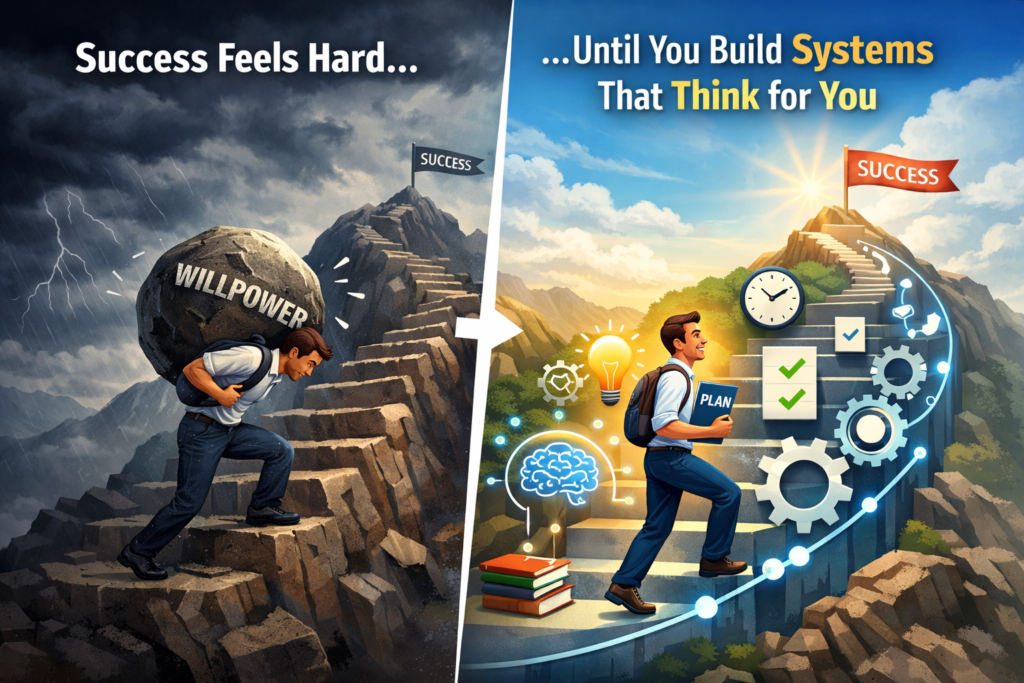
Many people believe success depends on motivation, discipline, or talent. However, decades of psychological and neuroscientific research show a different truth: human willpower is limited, but success systems can compensate for these limits. This article explores how scientifically validated concepts—such as ego depletion, implementation intentions, checklists, and neuroplasticity—explain why systems outperform motivation and how anyone can use them to make success sustainable.
Table of Contents
1. The Myth of Endless Willpower
Modern culture glorifies self-discipline, but psychology tells us that willpower is not infinite.
Scientific Foundation: Ego Depletion
Research by psychologist Roy Baumeister demonstrated that self-control behaves like a limited resource. When people use willpower repeatedly—resisting temptations, making decisions, forcing focus—it becomes depleted. This leads to decision fatigue, reduced persistence, and poor performance later in the day.
Key Insight:
When success depends only on willpower, failure becomes statistically likely.
This explains why people start strong but struggle to remain consistent.
2. Why Success Systems Beat Motivation
Motivation is emotional and unpredictable. Systems are structural and reliable.
A system is not a habit—it is an external or internal framework that guides behavior without requiring constant conscious effort.
Psychological Principle: Cognitive Load Reduction
The human brain is limited in how much information and decision-making it can handle at once. Systems reduce this burden by:
- Eliminating unnecessary choices
- Creating predictable routines
- Automating responses to common situations
Result: More mental energy is available for meaningful work.
3. If-Then Planning: Turning Goals into Algorithms
Scientific Foundation: Implementation Intentions
Psychologist Peter Gollwitzer found that people who pre-decide when and how they will act are significantly more likely to achieve their goals.
Example:
- Instead of: “I will try to study more.”
- Use: “If it is 7 PM, then I open my book and study for 30 minutes.”
This creates a mental algorithm that shifts behavior from conscious choice to automatic execution.
Why It Works:
- Reduces hesitation
- Eliminates negotiation with yourself
- Triggers action through context, not mood
4. Checklists: Proof That Even Experts Need Systems
Medical Evidence: The WHO Surgical Checklist
A landmark study led by Dr. Atul Gawande showed that a simple 19-step checklist reduced:
- Major surgical complications by 36%
- Deaths by 47%
These results were achieved not by better surgeons, but by better systems.
Psychological Explanation
Checklists prevent:
- Memory overload
- Attention lapses
- Overconfidence errors
Lesson:
Expertise does not eliminate human limitations—systems compensate for them.
Example: A Professional Chef in a Kitchen
Why Even Experts Need Checklists, Even an experienced chef follows a checklist before service:
Basic Kitchen Checklist
- Wash hands
- Check knife and tools
- Preheat oven
- Confirm ingredients are ready
- Clean workstation
The chef already knows all of this.
But during a busy service, pressure and distractions make mistakes more likely.
Why the Checklist Matters
- Prevents forgetting simple steps
- Reduces stress during peak hours
- Keeps quality consistent
- Frees mental energy for creative cooking
Without a checklist, mistakes happen not because of lack of skill, but because human memory is limited.
The Psychology Behind It (Short)
Checklists work because they:
- Reduce cognitive load
- Protect against attention lapses
- Turn complex tasks into reliable systems
This is why surgeons, pilots, engineers—and chefs—use checklists daily.
5. Training the Brain: When Systems Become You
Neuroscience Foundation: Neuroplasticity
Studies by Dr. Richard Davidson on Tibetan monks revealed extraordinary gamma-wave brain activity associated with focus, emotional regulation, and clarity.
This demonstrates that:
- The brain physically adapts to repeated behaviors
- What begins as effort can become automatic
- Systems practiced consistently can reshape neural pathways
Translation for Everyday Life:
Systems don’t just guide behavior—they rebuild the brain over time.
6. From Effort to Default: How Success Becomes Easier
When systems are applied consistently:
- Willpower is conserved
- Decisions are minimized
- Actions become automatic
- Identity begins to shift
Eventually, success stops feeling like resistance and starts feeling like default behavior.
Example: A Real-World Success System in Daily Life
A practical example of a success system is designing learning around existing routines instead of relying on motivation.
French Learning System
- Listening to French radio while walking to the station and working in the kitchen (passive input).
- Reading French comic books during train travel (light active input).
- No pressure to understand everything; repetition builds comprehension automatically.
Programming Learning System
- Using one daily break for focused learning.
- Studying only one technology at a time (either Python FastAPI or Golang).
- Working on one small, clearly defined task per session.
Why This Works
- Eliminates decision-making (“what should I study now?”)
- Uses dead time efficiently
- Separates passive learning from deep focus
- Reduces cognitive overload
This system turns learning into a default behavior, not a daily struggle—illustrating how well-designed systems make progress inevitable.
Conclusion: Success Is Not a Personality Trait
The scientific evidence is clear:
- Humans are not designed for constant self-control
- Motivation is unreliable
- Systems are psychologically efficient
Success is not about trying harder—it is about designing better systems.
When you build structures that work with the brain instead of against it, success stops being exhausting and starts becoming inevitable.
Final Message for Readers
Don’t ask, “How can I be more disciplined?”
Ask instead, “What system can make this unavoidable?”
Related Articles